
Best Poker Training Tools & Courses in 2027: What’s Actually Worth Paying For?
Ten years ago, studying poker mostly meant forum threads, a handful of training videos and whatever the regulars at your table were willing to tell you. Now you can spend nothing at all, or you can spend more than a small bankroll on courses, solver licenses, coaching packages and a pile of study software.
Here’s the uncomfortable part. Spending more does not mean learning faster. I’ve watched players buy every tool on the market and stay stuck at the same stakes for years, and I’ve watched others climb steadily with a tracker and a notebook full of their own hand reviews. The best poker training tools and courses in 2027 are the ones that fix the leak you actually have, not the ones with the biggest marketing budget.
So let’s go through it category by category.
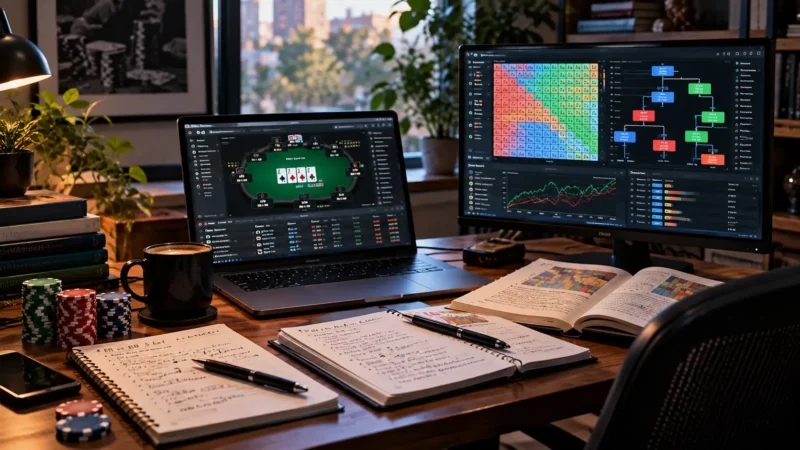
Structured Poker Courses
The biggest value of a good poker training course is that someone else has decided the order of things. Most stuck players don’t lack information. They lack a plan. They watch a river bluffing video on Monday, a 3-bet pot video on Wednesday, and by Friday they can’t remember much of either.
A well-built course moves from preflop foundations to postflop concepts in a sequence that makes sense, often with exercises along the way. That is very different from scrolling a video library and clicking whatever thumbnail looks interesting.
The catch is that courses age, and one built for live full-ring cash won’t do much for an online MTT grinder. Check our individual poker course reviews to see whether the material fits your format and how recently it was updated.
Poker Training Sites and Video Libraries
Subscription sites sit somewhere between a course and a content buffet. The best poker training sites have plenty of quality material, but the subscription model rewards consumption, not improvement. Watching a pro play for three hours feels productive. It usually isn’t, unless you pause, take notes and test the ideas in your own sessions.
If you subscribe, pick one learning path and ignore the rest of the library for a month. Our poker training site reviews compare how each platform organizes its content, which matters more than how much of it there is.
GTO Trainers
A GTO poker trainer puts you in a spot, makes you choose, then shows how far off you were. Simple idea, but it’s one of the better study methods available because it forces active recall instead of passive staring at solver outputs. Memorizing a chart is easy. Making the right decision under time pressure in a spot you’ve drilled fifty times is the actual skill.
For intermediate and advanced players, this kind of deliberate practice is probably the best value per hour of study. For beginners, I’m less convinced. If you call too much preflop and can never fold top pair, a trainer will mark you wrong repeatedly without fixing the reasoning behind it. Fix the obvious leaks first, then see our GTO trainer reviews for which tools suit which formats.
Poker Solvers
A poker solver calculates equilibrium strategies for specific spots based on the ranges and bet sizes you give it. It tells you what to do. It does not tell you why.
That gap is where a lot of money gets wasted. Players buy an expensive setup, run a few trees, copy the frequencies and end up with a strategy they can’t adjust against a recreational player who never bluffs. Building sensible trees also takes knowledge most people don’t have yet when they buy.
Most recreational and micro-stakes players don’t need a solver at all. If you’re curious, start with a beginner’s guide to using a poker solver and try cheaper or free options before paying for the top tier. Our solver reviews and guides cover the differences.
For intermediate and advanced players, this kind of deliberate practice is probably the best value per hour of study. For beginners, I’m less convinced. If you call too much preflop and can never fold top pair, a trainer will mark you wrong repeatedly without fixing the reasoning behind it. Fix the obvious leaks first, then see our GTO trainer reviews for which tools suit which formats.
Preflop Charts and Range Tools
Preflop is the easiest part of the game to fix and the cheapest. Good free ranges exist for most common formats. Paid range tools earn their keep mainly for players who need many stack depths or unusual formats, not for someone opening from the button at 10NL.
Coaching
One-on-one poker coaching gives you what nothing else does: feedback on your own decisions and thought process. A good coach can find the leak you didn’t know you had in twenty minutes.
It’s also the most expensive way to improve, and it only makes financial sense when the win rate gain shows up at stakes where it’s worth real money. A micro-stakes player paying a top coach is usually buying improvement worth less than the lesson.
Group coaching and coaching platforms are the middle ground. Less personal attention, but you still get hand reviews and accountability for a fraction of the cost. Our poker coaching reviews explain how different programs are structured.
Hand-History and Database Tools
This is where I’d push most improving players before buying another course. A tracker lets you filter your own hands, find the spots where you lose the most and review them with intent. Poker hand analysis based on your own results tells you what to study, which is half the battle. Our hand-history software reviews compare the main options.
Free Poker Training
Free poker training has never been better: videos, strategy articles, podcasts, hand-discussion forums and free tiers or trials of many poker study tools. A beginner can learn solid fundamentals without paying anything.
Free material falls short on structure, format-specific depth and feedback. Once you know roughly what to study but can’t organize it, or can’t tell whether your reasoning holds up, paying starts to make sense.

What Should You Actually Pay For?
Beginner or micro-stakes player. Very little. A tracker and maybe one well-reviewed beginner course. Free content plus regular review of your own hands will carry you a long way.
Low-stakes regular. A tracker, plus either a GTO trainer or a structured course, and possibly group coaching. This is where deliberate practice starts paying off.
Serious mid-stakes player. Now a solver earns its place, along with occasional one-on-one sessions aimed at specific weaknesses.
Advanced or professional player. Premium solver setups, specialist coaching and custom study work. Small edges are worth real money here, so expensive tools can actually pay for themselves.
Where to Put Your Money First
The best way to study poker isn’t the most expensive one. It’s the one aimed at your biggest leak. If you’re still deciding whether poker courses are worth it, start by comparing what a course can actually give you that free content, solvers and self-study can’t. It’s the one aimed at your biggest leak. Beginners need structure and fundamentals. Improving regulars get the most from deliberate practice and honest hand analysis. Advanced players are the ones who really extract value from solvers and personal coaching.
If you’re not sure where you stand, start with your own database. It’s the cheapest coach you’ll ever hire.
Poker Courses, Solvers & Training Tools FAQ
The best poker training tools depend on your skill level and biggest weaknesses. Beginners usually benefit most from structured courses, free training content and hand-history review. Low-stakes regulars can get more value from GTO trainers and database tools, while serious mid-stakes and professional players are more likely to benefit from solvers and specialist coaching.
Paid poker courses can be worth it when you need structure rather than more information. A good course organizes concepts in a logical sequence, from fundamentals to more advanced strategy. Before paying, make sure the course matches your game format, stakes and experience level, and check how recently the material was updated.
Most beginners and micro-stakes players do not need a poker solver. Solvers can calculate equilibrium strategies, but understanding and applying those outputs requires a solid strategic foundation. Beginners will usually improve faster by fixing preflop mistakes, reviewing their own hands and developing better fundamentals first.
GTO trainers can offer excellent value for intermediate and advanced players because they turn studying into active practice. Instead of simply looking at solver outputs, you repeatedly make decisions and receive immediate feedback. Beginners may get less value until they understand why certain decisions are correct or incorrect.
A hand-history tracker or database tool is often the best first investment. It allows you to analyze your own play, identify recurring leaks and decide what actually needs improvement. After that, one well-reviewed beginner course may provide enough structure to guide further study.
Free poker training can be enough to build strong fundamentals. Strategy articles, videos, podcasts, forums and free versions of study tools provide more quality information than ever before. The main weaknesses of free training are usually a lack of structure, personalized feedback and deeper format-specific material.
Poker coaching makes the most sense when personalized feedback can produce a meaningful financial return. A good coach can quickly identify problems in your decision-making that are difficult to spot yourself. For lower-stakes players, group coaching can offer better value, while one-on-one specialist coaching becomes more attractive as the stakes increase.
A structured poker course follows a predefined learning path, while training sites typically provide larger libraries of videos and strategy content. Courses are usually better for players who need direction. Training sites can be more flexible, but players need discipline to avoid consuming random content without applying what they learn.
A solver becomes more useful once you have strong fundamentals and need to study specific strategic situations in greater depth. Serious mid-stakes players and professionals are more likely to justify the cost and complexity because relatively small strategic improvements can have meaningful financial value.
Spend money on the problem that is currently limiting your game. Beginners should prioritize fundamentals and structure. Improving regulars should focus on hand analysis and deliberate practice. Advanced players can justify more specialized investments such as solvers and private coaching. Buying more tools rarely helps if you have not identified what you actually need to improve.