
GTO vs Exploitative Poker in 2027: What Should You Actually Study?
Almost anyone can open a solver output now. Preflop charts are free, GTO trainers have free tiers, and every common spot has been run a thousand times by someone. Yet the typical low-stakes pool doesn’t play that much better than it did a few years ago. Access to correct answers turned out to be the easy part. Turning them into better decisions at the table is where most players stall.
Part of the problem is how the topic gets framed. “GTO or exploitative?” sounds like a choice between two schools. In practice nobody good plays either one in pure form. The more useful question is how much theory you need before your exploits stop being guesses
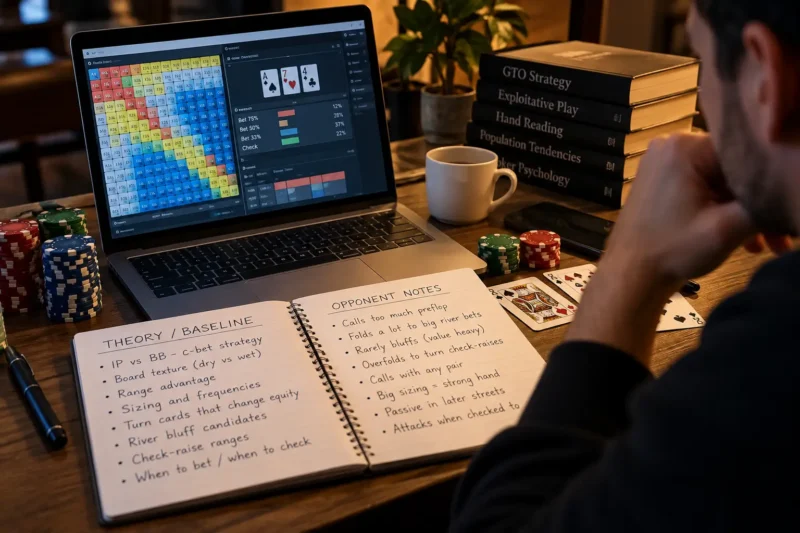
GTO and Exploitative Play, Briefly
GTO is a baseline. It’s a strategy built so that no opponent can profit by adjusting against it. It doesn’t try to win the most against anyone in particular. It tries to lose to nobody.
Exploitative play means deliberately moving away from that baseline because you have evidence that someone makes a predictable mistake. Folding more to a player who never bluffs rivers. Betting thinner against someone who calls with any pair.
Notice that the second idea depends on the first. You can’t deviate from a baseline you don’t know. Building that baseline doesn’t have to mean memorizing solver outputs. A structured GTO poker course can be a faster way to understand the principles behind the frequencies.
Where Copying the Solver Goes Wrong
Say the solver bets a hand 40% of the time and checks it 60% in some flop spot. Plenty of players respond by trying to randomize that hand at roughly those frequencies. That’s mostly wasted effort. A mixed strategy usually means the options are close in EV, so the exact split matters far less than understanding why the hand is close. Does it want protection but block the folds you’re hoping for? Is it too strong to give up and too weak to build a big pot? That reasoning carries over to other boards. The 40% doesn’t. If you’re using a solver for study, learning how to interpret solver results is far more useful than trying to memorize every mixed frequency.
The opposite mistake is just as common. A player decides the pool never bluffs rivers and starts folding everything that can’t beat a value bet, with no idea what a reasonable calling range would look like. Sometimes that’s a great exploit. Sometimes it’s massive overfolding, and they never find out because they never see the cards.
What the Baseline Gives You
Theory study isn’t about memorizing trees. It’s about knowing why strategies look the way they do.
Position and preflop ranges decide what each player can hold when the flop comes. Board texture decides who that flop favors. A player with the range advantage can often bet frequently and small, while the player holding most of the nutted hands can use bigger sizes. Bet size in turn shapes how many bluffs a polarized range can carry and how often the other side needs to defend. Common turn and river patterns, like which cards shift equity toward the caller, follow from all of this.
Once that intuition is in place, other people’s mistakes become visible. You notice that someone defends the big blind far too tightly. That a regular only uses a big turn sizing with value. That the pool calls small river bets with almost anything but folds to overbets far too often. Without the reference point, those are just hands that happened.
Exploits That Tend to Pay
These are examples, not laws. Pools vary by site, stake, format and even time of day.
Many lower-stakes pools call too much early and play too passively later. Many under-bluff rivers, especially in big raised pots. Some over-bluff specific lines, often missed draws on obvious runouts. Blind defense is frequently off in one direction or the other. Sizing tells are common, with one size for strong hands and another for draws. And thin value bets get skipped constantly.
There’s a real difference between exploiting one player and exploiting a population. A single opponent’s tendencies need a decent sample before you lean on them hard. A population tendency backed by thousands of hands in your database is far more reliable and can be built into your default strategy. This is also where population analysis becomes much more useful than trying to build an exploit from a handful of hands against one opponent. Treating three hands against one person as a population read is how exploits turn into leaks.
Low Stakes
At micro and low stakes, memorizing precise solver frequencies is rarely the best use of your study hours. The money is in bigger, simpler errors. Value bet more and thinner. Stop paying off big river raises from passive players. Attack pots where opponents check and give up. Fold less to weak, aimless aggression.
That doesn’t make theory irrelevant. You still need enough of it to know what you’re deviating from and why. A player who understands why a range checks in a certain spot can tell when a weak opponent’s check means they’ve given up. Learn the structure, skip the decimals. If you’re still building those fundamentals, start with affordable poker courses for low-stakes players before spending serious money on advanced solver training.
Mid Stakes
As opponents improve, the obvious exploits shrink. Regulars don’t make the big mistakes that pay for low-stakes games, and some of them are actively looking for your deviations. An aggressive adjustment that prints against recreational players can get punished by someone who notices it.
This is where stronger theory starts paying directly. Edges come from small, specific deviations in spots that come up often: turn barreling, river sizing, how ranges are built after a check-raise. You need a more accurate baseline both to find those edges and to keep your own strategy hard to attack. Solver work and GTO trainers make a lot more sense here than they do at 10NL.
So What Should You Study?
Build enough theory to explain your baseline in plain language: why a range bets, why that size, who should be defending and roughly how often. Then spend real time in your own database learning what your pool actually does.
The ratio shifts as you move up. At low stakes, lean heavily on fundamentals and population reads. At mid stakes and above, put more hours into precise theory, because the mistakes you’re exploiting get smaller and the players punishing yours get better. At every level the goal is the same. Deviate on purpose, for a reason you can name.
GTO vs Exploitative Poker: Common Questions
Neither is universally better. GTO gives you a solid baseline, while exploitative poker helps you make more money when opponents have predictable leaks. Strong players use both depending on the situation.
Yes, but beginners don’t need to memorize precise solver frequencies. Start with preflop ranges, position, board texture, range advantage and basic betting principles. The goal is to understand why a strategy works.
Exploitative poker means deliberately adjusting your strategy to take advantage of an opponent’s mistakes. Examples include folding more against players who rarely bluff or value betting thinner against players who call too often.
You can make profitable adjustments without advanced GTO knowledge, but a theoretical baseline makes those adjustments more reliable. Without one, it can be difficult to tell whether you’re exploiting an opponent or creating a leak in your own game.
Low-stakes players benefit from understanding GTO fundamentals, but precise solver frequencies usually shouldn’t be their main focus. Fundamentals, value betting, population tendencies and fixing obvious leaks generally deserve more study time.
Deviate when you have credible evidence that an opponent or player pool consistently makes a specific mistake. The stronger your evidence, the more confidently you can adjust away from the theoretical baseline.
No. Solvers are useful, especially as you move into tougher games, but you can learn many GTO concepts through courses, trainers, range tools and structured hand analysis. Understanding solver output is more important than simply memorizing it.
A population exploit is an adjustment based on tendencies shared by a large group of players rather than one specific opponent. For example, if your database shows that a pool consistently under-bluffs a particular river line, you may profitably fold more often in that spot.
Mid-stakes players generally need a stronger theoretical foundation because opponents make fewer obvious mistakes and are more capable of exploiting weaknesses themselves. Exploitative adjustments still matter, but they tend to become smaller and more specific.
Learn enough theory to explain what the baseline strategy is trying to accomplish, then compare it with what opponents actually do. Use solver or trainer work for the baseline and your own hand histories and database for population and opponent tendencies.