
How AI Is Changing Poker Study in 2027 - And What It Can’t Do for You
Solvers have been part of serious poker study for years, so the idea that computers can find strong strategies isn’t news. What has changed is the distance between playing a hand and studying it. That gap used to be measured in evenings. You exported hands, picked a few, built trees, waited for the sim, then tried to work out what the output meant. More and more, it’s measured in minutes.
A realistic study loop now looks something like this. Play a session. Flag the hands that felt wrong. Compare your lines with a theoretically sound strategy. Notice which mistakes keep coming back. Drill those spots, get immediate feedback, and repeat the ones you still miss.
None of those steps is new. What’s new is that software handles most of the busywork between them, and that matters more than it sounds. Hours spent clicking through solver trees with no particular question in mind feel like study, but they rarely change how you play. A tight loop built around your own mistakes usually does.
Faster Hand Review, With a Catch
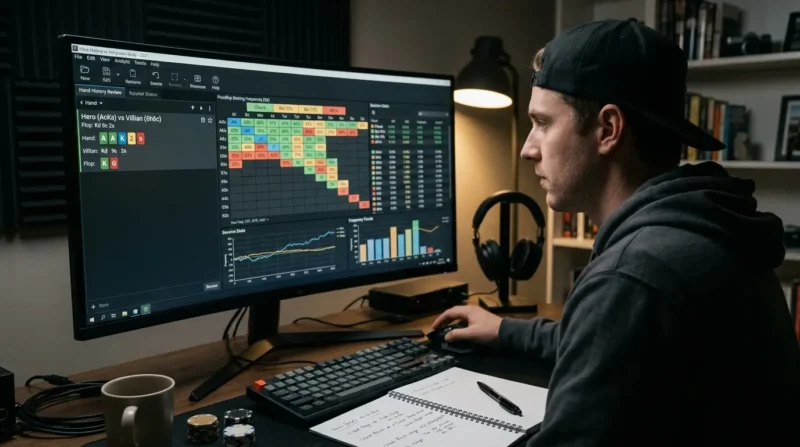
The most useful AI-assisted features are the boring ones. Sorting a session so the difficult hands rise to the top. Grouping similar spots, so you look at all your turn probes in single-raised pots together instead of one at a time. Comparing the line you took with the alternatives. Pointing out which hands deserve proper solver time and which were routine.
Some tools also explain the reasoning in plain language, and this is where you need to be careful. An explanation is not proof. A model can write a fluent, confident paragraph about range advantage and blockers that is simply wrong for the spot. If the explanation isn’t tied to an actual solved output under the right parameters, treat it as a hypothesis.
What ChatGPT Is (and Isn't) Good For
General assistants like ChatGPT have a real place in poker study. They’re good at explaining terminology, talking through concepts like polarization or minimum defense frequency, turning messy notes into something organized, writing quiz questions from your own material and helping you plan a weekly routine you’ll actually stick to. Talking through a hypothetical hand with one can sharpen how you think about it.
What a general assistant isn’t is a solver. It usually isn’t working from exact ranges, stack depths, rake, bet-size trees or ICM pressure, and any of those can flip the correct play. Ask whether to call a river shove and you’ll get an answer that sounds reasonable. Whether it’s right is a question it can’t verify for you. Use it to think, not to settle arguments.
Instant Solver Outputs
Precomputed solutions and fast solving mean you no longer have to configure and run every simulation yourself before getting useful feedback. Speed matters because feedback loops work best when they’re short. Reviewing a mistake the same day, while you still remember why you made it, beats meeting it two weeks later as an abstract spot.
The flip side is dependence. When the answer arrives instantly, it’s tempting to read it and move on. Knowing that the solver prefers a small c-bet on a given board isn’t the same as understanding why: which hands want to bet, what the opponent’s range can’t withstand, why a bigger size gains so little. If you can’t explain the output in a sentence or two, you haven’t learned it. You’ve seen it.
Automated Leak Detection
This is probably the most valuable change, and it comes down to volume. Reviewing ten hands tells you about ten hands. Software that compares thousands of your hands against a baseline can surface patterns you’d never catch manually, like folding too often to turn probes, under-bluffing one specific river line or defending the big blind too tightly against small opens.
A flagged leak is still only a starting point. Some “leaks” are sensible adjustments to your pool, and some are just sample noise. Telling the two apart takes judgment, plus enough hands to trust the pattern.
Where the Line Is
Everything above happens away from the table. Software that helps you decide while a hand is in progress is a different thing entirely. Real-time assistance (solvers, charts or AI tools feeding you advice during a hand) is prohibited on reputable poker sites, and they actively look for it. Getting caught can cost you your account and your balance. Rules on what’s allowed during a session, such as HUDs or static reference material, vary from site to site, so read the terms instead of assuming.
The simple rule: these tools are for review. Nothing should be answering questions for you while your clock is running.
What AI Can't Do for You
It can’t sit in the game. It doesn’t notice a regular’s sizing change after he’s lost three buy-ins, doesn’t register that the table tightened up when the fish left, and doesn’t make the call when you’re tired, stuck and facing a river jam in a spot you’ve never studied. Turning information into judgment under pressure is still your job.
What AI can do is shorten the path from mistake to lesson. Used well, that’s a real edge over players still studying the old way. Used lazily, it’s just a faster way to collect outputs you don’t understand. Let the software find your mistakes and serve them back to you quickly, then do the thinking yourself.
AI in Poker Study: Common Questions for 2027
AI is making poker study faster by helping players sort hands, identify recurring mistakes, group similar situations and receive quicker feedback. The biggest improvement is not replacing traditional study, but shortening the time between making a mistake and reviewing it.
AI can help organize and discuss poker hands, but its analysis is not automatically correct. Accurate strategic answers often depend on exact ranges, stack depths, rake, bet sizes and tournament conditions. Important decisions should still be checked against reliable solver outputs.
Yes. ChatGPT can explain poker concepts, organize study notes, create quizzes, build study routines and help players think through strategic ideas. It is most useful as a learning assistant rather than a source of exact optimal decisions.
No. A poker solver calculates strategies using specific ranges, stack sizes, betting trees and other parameters. ChatGPT can explain solver concepts and help interpret ideas, but it should not be treated as a substitute for actual solved outputs.
AI-assisted leak detection analyzes large numbers of hands to identify recurring strategic mistakes. It may reveal patterns such as overfolding certain turns, defending the big blind too tightly or under-bluffing particular river situations.
AI tools are generally intended for off-table study. Using software that provides strategic advice while a hand is being played may violate a poker site’s rules. Players should always check the specific platform’s terms regarding real-time assistance, HUDs and reference tools.
Poker study tools are used after a session to review hands, study ranges and improve strategy. RTA provides strategic information or recommendations while a hand is in progress. That distinction is important because reputable poker platforms typically restrict or prohibit real-time assistance.
They can make studying more efficient, but they cannot replace understanding and judgment. The most effective approach is to use AI to identify and organize mistakes, use reliable solver data where appropriate, and then study why the better strategy works.